
Everything I was thinking about while I was writing my book
This should have been my author's note.
Currently: Procrastinating before I go and pick my kids from after school club.
Reading: The Parable of the Talents by Octavia E. Butler
Watching: Kaos on Netflix
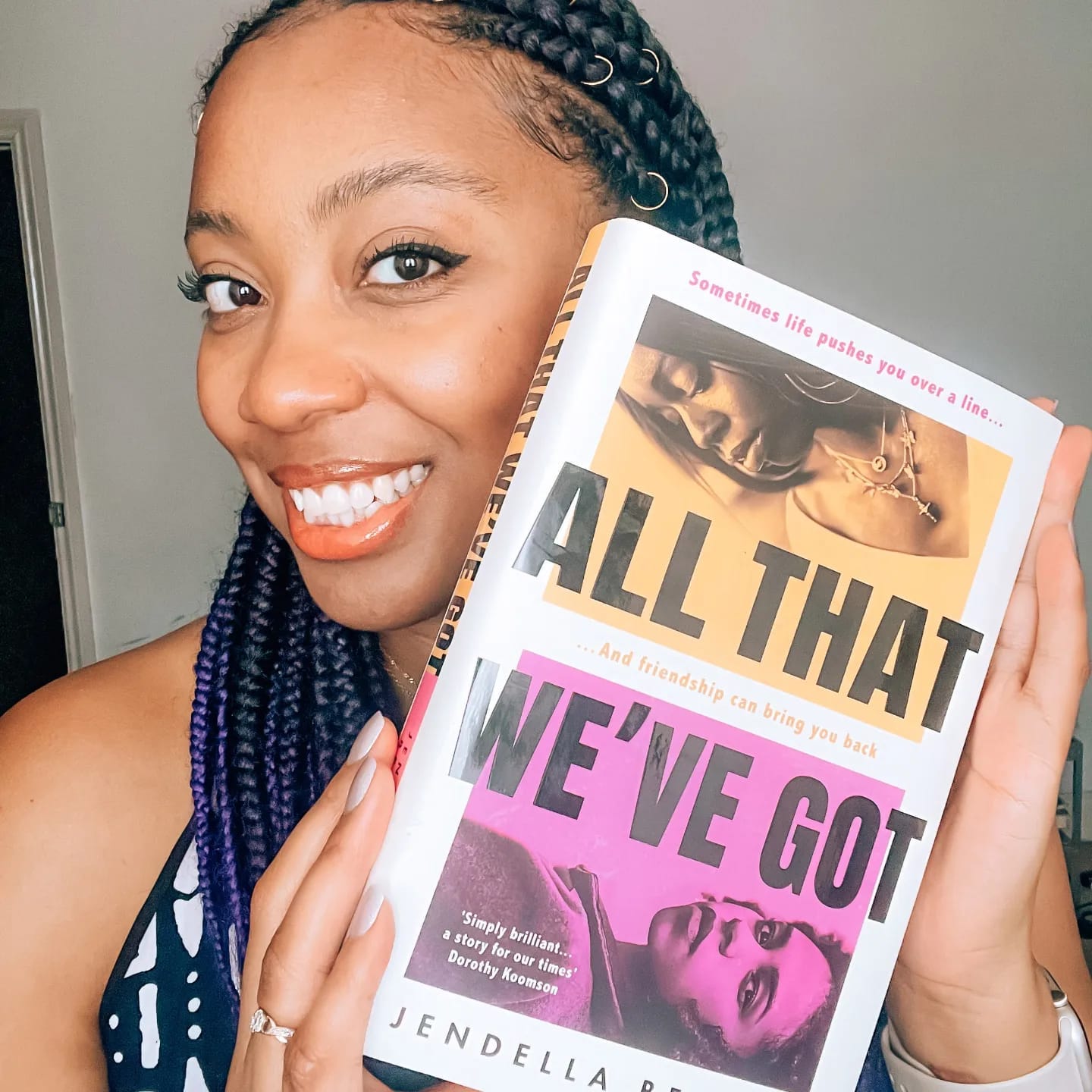
Listening: The ALL THAT WE’VE GOT playlist I made on Spotify.
Thinking: How I feel about Keir ‘Stab-You-In-The-Back’ Starmer bears no impact on how I feel about MPs like Diane Abbott – who I edited for her newsletter takeover of Black Ballad and who I will also be interviewing in Bath in October…stay tuned for those details in the next edition.
On 22nd May 2024, the then-British Prime Minister Rishi Sunak called a snap General Election. As soon as I saw that he had called it, I knew instinctively that it would be Thursday 4th July 2024.
Why? Because that was the day my second novel was due to be published, and having a much-anticipated General Election overshadow the launch of my novel was in keeping with the general tone of my book campaign up until then.
I went to bed ruminating on everything. All That We’ve Got is more explicitly political that my debut novel – even if it’s not Politics With A Capital P (i.e. Party Politics). But still, I knew that trying to get any sort of media interest in the book would be a hard ask.
I woke up and wrote out some thoughts. Thoughts that should have ended up in the final author’s note at the end of the book, but by the time it came to write that bit, after countless rounds of edits my brain was so fried, all I could manage was one coherent sentence: “The city that Mimi and Abi live in is fictional, but the world that they inhabit is real.”
Surprise, surprise: no one in ‘the media’ did care about the book, haha. But the streets love our girls.
On my birthday, my friend happened to walk past an older gentleman reading All That We’ve Got on a bench in North London. She sent me a voicenote of the tail end of their conversation: “I’d put it in the category of a proper book, but this is different. You can see it’s written by a very well-educated person. You can see that she’s dealing with proper matters, but she’s got such a light touch that you’re going through the pages without realising it.”
Mission accomplished. Job done.
I’m reminding myself about all of this as I gear up for a few events this autumn, and I remembered the belated Author’s Note I wrote. Even though Sunak’s Conservative government was ousted and we now live under Keir Starmer’s Labour, too little has actually changed.
Instead of raising money by appropriately taxing the wealthy, Starmer threatens to ‘reform’ the NHS, at the same time that he sends billions to Ukraine and Britain plays handmaiden to genocide. I still stand by my statement that Keir Starmer looks like a Tory plant, but enough of him, here’s that Author’s Note…
23rd May 2024
The very first General Election I ever voted in resulted in the ill-fated 2010 Conservative-Liberal Democrat coalition. By then we were two years deep into a worldwide recession, and I had already felt the suffocating economic impact in my family and witnessed those tragic dominoes fall in the lives of those around me. But the election of a ‘ConDem’ government felt like a blow it would be infinitely harder to recover from.
I was in my second year of university at the time. The morning after the result, I remember walking onto campus and the atmosphere was palpably muted. No one was explicitly talking about the result, but I know many of my fellow students had voted Lib Dem, inspired in great part by their promise of abolishing university tuition fees. With Nick Clegg’s party joining forces with the Tories, that promise seemed already broken before things had even gotten started, and the concern felt that morning has been justified a thousand times over.
Besides tuition fees tripling and a hostile immigration stance seeing international students consider other options, on a wider national scale, the picture could be said to be even grimmer. Since 2010, child poverty has increased to the point where 30% of children in the UK are classed as in poverty – with the majority of those children having at least one parent in work.
Local authorities are in financially worse situations than ever before with some council budgets having been slashed by 50% since 2010. The public is told there is “no magic money tree” to alleviate our economic distress, while hundreds of millions of taxpayer pounds are funnelled into failed private businesses with ties to Conservative lords or £900,000 is spent repainting a prime minister’s plane.
All of this was on my mind as I was writing All That We’ve Got. Particularly, the issues faced by Abi and her family in terms of in-work poverty and deportation can be traced directly to decisions made by the Conservative government. The political solutions for the average person in Britain are few and far between with an adversarial political system that rewards careerist politicians and private interests with endless money.
Poverty is the compounding factor in everything from ill health to serious youth violence and child exploitation, yet there is little to no political will to seriously and permanently address this.
The phrase that ended up being repeated throughout drafts of my book was “we are all that we’ve got”, and it is something that I truly believe. Having been socialised in a capitalist, individualist society based on hierarchy and the thin myth of meritocracy means that the practical outworking of trusting, relying and being there for each other as a wider community is still a battle, but it is a fight worth the effort.
Nigerian poet, critic, feminist and activist Molara Ogundipe-Leslie wrote in an essay on African Marxists and feminism, “We do not want to change society at the political and economic level only. We should also change society at the attitudinal, motivational levels, thereby changing the effective, psychic structures of persons.”
This is the journey that I went on with my characters, Mimi in particular. Widespread change is not possible, or lasting without the individual “internalis[ing] the values of the revolution”. The values of hyper individualistic capitalism, ironically, are a threat to us as a individuals because they are an existential threat to our communities. It is in our own interests to care for and about each other.
As Britain heads towards a much-needed General Election, I must admit that my faith in the political system is lower than it has ever been, while the problems we face as a country and as a global community feel, at times, insurmountable. But despair is not an option. We very literally cannot afford to give up hope.
While politicians and those that claim to be working in the public interest should always be held to account, they have proven time and again that they will not be our salvation. Our fates are tied to one another as neighbours, citizens and ordinary people on the short end of a long rope. We really are all that we’ve got.
Upcoming Events
Saturday 28th September: How Publishing Works Masterclass (Birmingham Literature Festival)
Sunday 29th September: The Book Alert Book Club (online)